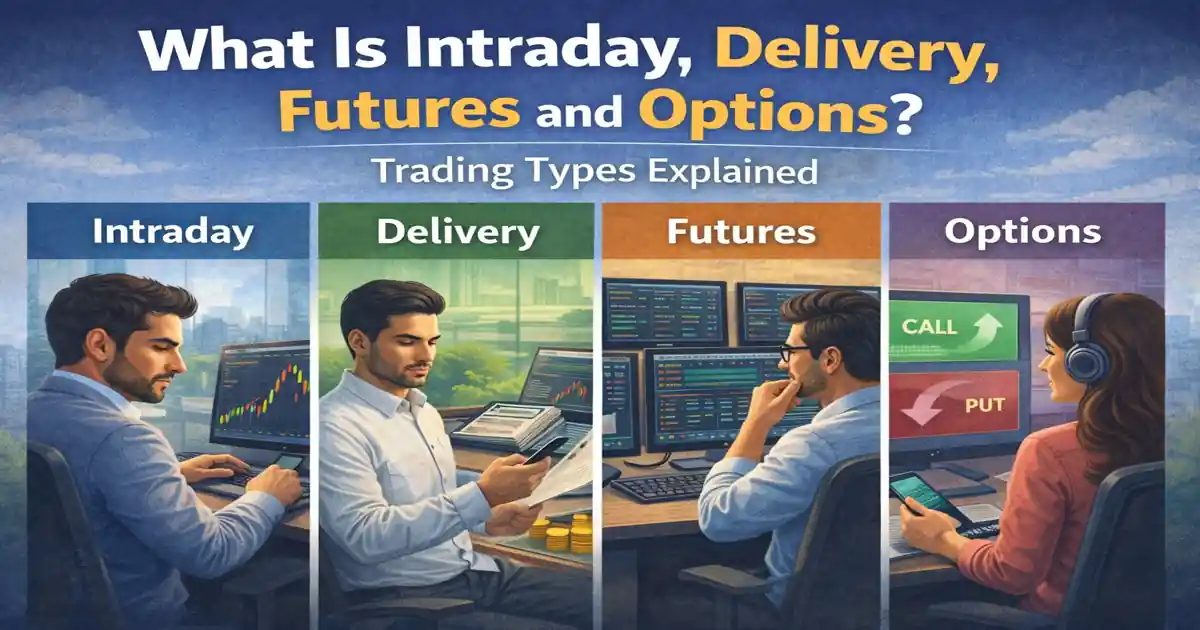
If you’ve ever opened a trading app in India, you’ve probably seen options like Intraday, Delivery, Futures, and Options.
For beginners, these terms can feel confusing — and sometimes intimidating.
So what do they actually mean?
How are they different?
And why do people choose one type over another?
In this guide, we’ll break down the four major trading types in the Indian stock market, using simple explanations, real examples, and clear comparisons.
📌 The Four Main Types of Trading in India
In the Indian market (on exchanges like NSE and BSE), trading is broadly categorized into:
- Intraday Trading
- Delivery Trading
- Futures Trading
- Options Trading
Let’s understand each one clearly.
1️⃣ What Is Intraday Trading?
Simple Meaning:
Intraday trading means buying and selling a stock on the same day.
You cannot carry the position overnight.
Example:
- You buy 100 shares at ₹200 at 10:00 AM
- You sell them at ₹210 at 2:00 PM
- Profit = ₹10 per share
If you forget to sell, the broker usually squares it off automatically before market close.
Key Features of Intraday:
✔ Positions must be closed before 3:30 PM
✔ Higher leverage available
✔ Focus on short-term price movements
✔ Higher risk due to volatility
📊 Interesting fact:
A large percentage of daily equity volume in India comes from intraday trades.
2️⃣ What Is Delivery Trading?
Simple Meaning:
Delivery trading means buying shares and holding them beyond one day.
You become a shareholder.
Example:
- You buy shares at ₹200
- You hold for 6 months
- Price rises to ₹260
- You sell later
Unlike intraday, delivery allows long-term holding.
Key Features of Delivery Trading:
✔ No compulsion to sell same day
✔ Shares credited to Demat account
✔ Lower risk compared to derivatives
✔ Suitable for long-term investors
📌 Important:
Delivery trading forms the backbone of wealth creation in equity markets.
3️⃣ What Is Futures Trading?
Futures trading happens in the derivatives segment.
Simple Meaning:
A futures contract is an agreement to buy or sell an asset at a fixed price on a future date.
You don’t buy actual shares — you trade a contract.
Example:
Suppose a stock is trading at ₹1,000.
You enter a futures contract expecting price to rise.
If it rises to ₹1,050, the difference becomes your profit.
Key Features of Futures:
✔ Contract-based trading
✔ Fixed expiry date (monthly)
✔ High leverage
✔ Requires margin money
📊 In India, most futures trading happens on the NSE derivatives segment.
4️⃣ What Is Options Trading?
Options are also derivatives but slightly more complex.
Simple Meaning:
An option gives you the right, but not the obligation, to buy or sell at a specific price before expiry.
There are two types:
- Call Option → Right to Buy
- Put Option → Right to Sell
Example:
If you believe a stock will rise:
You buy a Call Option.
If it rises above your strike price:
You gain.
If not:
Your loss is limited to the premium paid.
Key Features of Options:
✔ Limited risk for buyers
✔ High leverage
✔ Weekly and monthly expiry
✔ Complex strategies possible
📈 India has become one of the largest options trading markets globally by volume.
📊 Intraday vs Delivery vs Futures vs Options
| Feature | Intraday | Delivery | Futures | Options |
|---|---|---|---|---|
| Holding Period | Same Day | Long Term | Till Expiry | Till Expiry |
| Ownership | No | Yes | No | No |
| Leverage | High | Low | High | Very High |
| Risk Level | Medium-High | Moderate | High | High |
| Suitable For | Active traders | Long-term investors | Experienced traders | Advanced traders |
🧠 Which Is Most Common in India?
- Beginners often start with delivery trading.
- Active traders prefer intraday.
- Experienced participants trade futures & options.
📊 According to exchange data, derivatives trading volume (F&O) in India often exceeds equity cash market volume.
💡 Why So Many Trading Types Exist?
Different traders have different goals:
- Short-term momentum
- Long-term growth
- Hedging risk
- Income generation
The market provides multiple instruments to suit varied needs.
🏛 Role of Regulation
All trading activities are regulated by SEBI.
SEBI ensures:
- Fair trading practices
- Transparency
- Risk management systems
⚠ Common Misconceptions
❌ Futures and Options mean guaranteed profit
❌ Intraday is easy money
❌ Delivery has zero risk
✔ Reality:
Every trading type involves risk.
Understanding structure is more important than chasing returns.
📌 Real-World Scenario
Imagine:
- A long-term investor buys shares via delivery.
- A short-term trader trades intraday volatility.
- A professional hedges portfolio using options.
All operate in the same market — but with different strategies.
💬 A Thought to Remember
“Markets reward knowledge and discipline more than speed.”
Understanding trading types helps you interpret financial news and market discussions more clearly.
🎯 Key Takeaways
- Intraday = same-day trading
- Delivery = long-term ownership
- Futures = contract-based trading
- Options = right without obligation
- All are regulated and structured
Final Words
Knowing the difference between Intraday, Delivery, Futures, and Options builds foundational clarity about how modern stock markets operate.
You don’t need to trade everything — but you should understand what each term means when you hear it in financial news.
📌 Disclaimer
This article is for educational and informational purposes only. It does not constitute financial or trading advice.