If you’re planning to enter the Indian stock market, the first terms you’ll hear are Demat Account and Trading Account.
But many beginners ask:
- Are they the same thing?
- Do I need both?
- What exactly do they do?
In this complete beginner guide, we’ll clearly explain what Demat and Trading accounts are, how they work in India, their differences, real-life examples, and why both are essential for stock market participation.
📌 What Is a Demat Account?
Simple Meaning
A Demat Account (Dematerialized Account) is an account that stores your shares and securities in electronic form.
Before 1996, shares in India were issued as physical paper certificates. Today, everything is digital.
Who Manages Demat Accounts in India?
Demat accounts are maintained by two central depositories:
- NSDL
- CDSL
These depositories operate under regulation from SEBI.
Example of Demat Account
Imagine:
- You buy 10 shares of a listed company.
- Instead of receiving paper certificates,
- They are credited to your Demat account digitally.
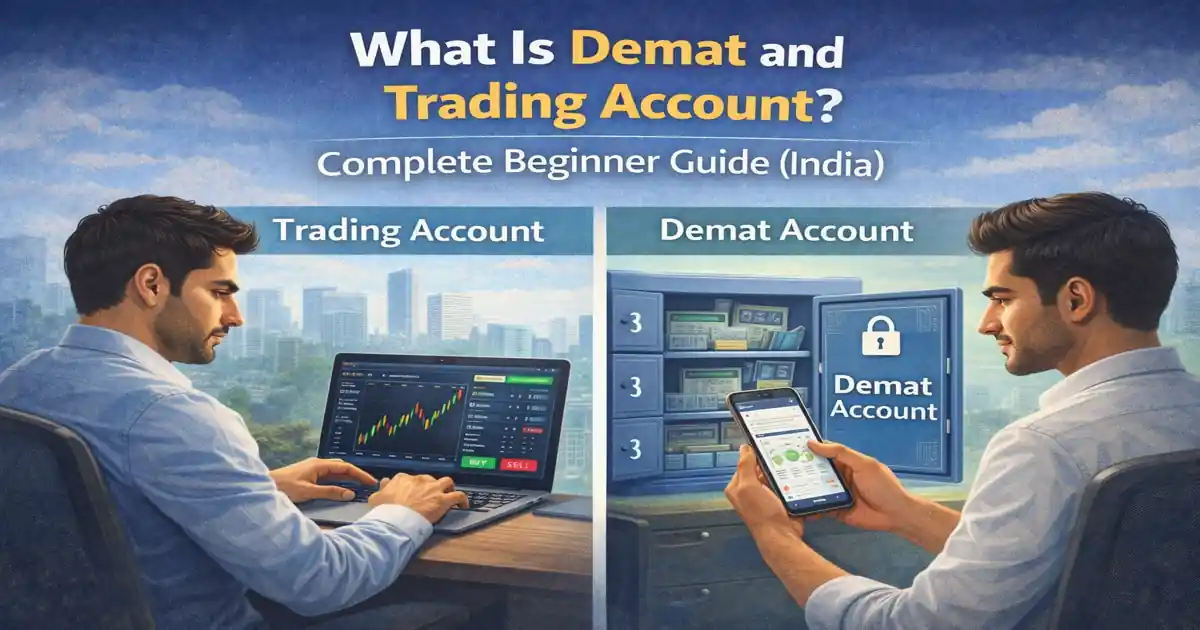
Think of a Demat account like:
📦 A digital locker for your shares.
📌 What Is a Trading Account?
Simple Meaning
A Trading Account is used to buy and sell shares on stock exchanges like:
- NSE
- BSE
It acts as a bridge between your bank account and stock exchange.
Example of Trading Account
When you:
- Log into your broker app
- Select a stock
- Click “Buy”
That order goes through your Trading Account to the exchange.
🔁 How Demat and Trading Accounts Work Together
Here’s how the complete process works:
1️⃣ You transfer money from bank to trading account
2️⃣ You place a buy order
3️⃣ Shares are purchased on NSE/BSE
4️⃣ Shares are credited to your Demat account
5️⃣ When you sell, shares are debited from Demat
6️⃣ Money goes back to your bank
📊 Quick Comparison: Demat vs Trading Account
| Feature | Demat Account | Trading Account |
|---|---|---|
| Purpose | Stores shares | Buys & sells shares |
| Type | Storage account | Transaction account |
| Holds Money? | No | No (linked to bank) |
| Holds Shares? | Yes | No |
| Mandatory? | Yes | Yes |
🏦 Why Do You Need Both?
You cannot:
- Buy shares without a Trading Account
- Hold shares without a Demat Account
Both are mandatory for equity investing in India.
📈 Growth of Demat Accounts in India
India has seen a massive rise in Demat accounts.
📊 According to recent exchange data:
- India crossed 13+ crore Demat accounts
- Retail participation has grown sharply since 2020
This shows increasing awareness about stock market investing.
💡 What Can You Hold in a Demat Account?
A Demat account can store:
- Equity shares
- Bonds
- Government securities
- Mutual fund units
- ETFs
- IPO allotments
🔐 Is a Demat Account Safe?
Yes.
Since accounts are maintained through:
- NSDL
- CDSL
And regulated by SEBI, investor protection systems are strong.
You also receive:
- SMS alerts for transactions
- Email confirmations
- Monthly statements
📱 What Is 3-in-1 Account?
Many banks offer:
- Bank Account
- Trading Account
- Demat Account
All linked together.
This simplifies fund transfers and trading.
💰 Charges Involved
While opening may be free, there are usually:
- Account Maintenance Charges (AMC)
- Brokerage charges
- Transaction charges
Always check fee structure before opening.
🧠 Common Beginner Doubts
❓ Can I open only Demat?
No. You need Trading account to transact.
❓ Can I open only Trading?
No. Shares must be stored in Demat.
❓ Is Demat only for stocks?
No. It can hold multiple financial instruments.
📌 Real-Life Example
Rahul wants to invest in shares.
- He opens Demat & Trading account with a broker.
- Transfers ₹10,000 from bank.
- Buys shares worth ₹8,000.
- Shares go to Demat.
- Later sells at ₹9,000.
- Profit credited to bank.
Simple, structured, digital.
🏛 Who Regulates the Entire System?
Everything operates under:
SEBI
SEBI ensures:
- Transparency
- Investor protection
- Fraud prevention
💬 A Simple Analogy
Think of:
- Trading Account = Shopping cart
- Demat Account = Storage cupboard
You buy through one.
You store in the other.
🎯 Key Takeaways
- Demat stores securities digitally
- Trading executes buy/sell orders
- Both are mandatory
- Regulated by SEBI
- Managed by NSDL/CDSL
📝 Final Words
Understanding Demat and Trading accounts is the first step toward stock market literacy in India.
You don’t need advanced knowledge — but you do need clarity about how the system works.
As Warren Buffett once said:
“Risk comes from not knowing what you’re doing.”
Knowing the basics removes unnecessary fear and confusion.
📌 Disclaimer
This article is for educational and informational purposes only. It does not constitute investment or financial advice.