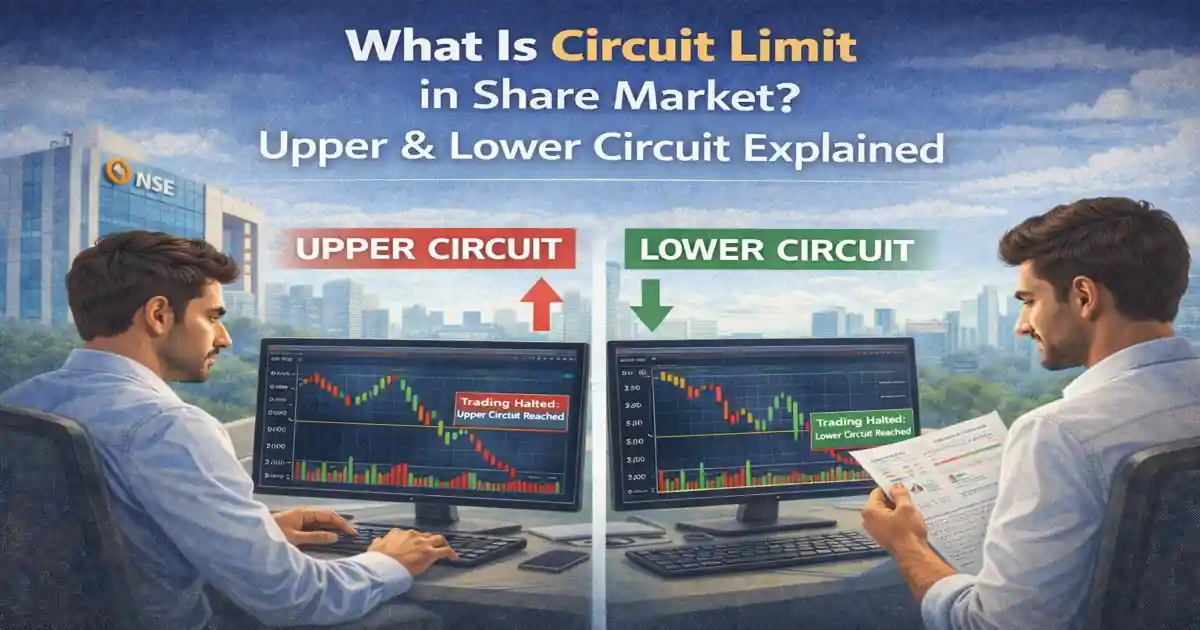
If you’ve ever seen a stock suddenly stop trading or noticed terms like “Upper Circuit Hit” or “Lower Circuit Triggered”, you may have wondered:
- What is circuit limit in share market?
- Why trading stops in stocks?
- What does upper circuit lower circuit meaning actually indicate?
In this comprehensive guide, we’ll clearly explain the circuit limit in share market, how it works, and why it exists — using real examples, facts, and simple explanations.
📌 What Is Circuit Limit in Share Market?
A circuit limit is a price band set by the stock exchange that restricts how much a stock can rise or fall in a single trading day.
Once a stock reaches this limit:
- Trading may stop temporarily
- Or further buying/selling beyond that price is not allowed
It acts as a safety mechanism to prevent extreme volatility.
🎯 Why Circuit Limits Exist
Stock markets are driven by emotions — fear and greed.
During panic or hype:
- Prices can move irrationally
- Investors may make impulsive decisions
Circuit limits are designed to:
- Prevent manipulation
- Protect retail investors
- Maintain market stability
📈 Upper Circuit Lower Circuit Meaning (Simple Explanation)
🔼 Upper Circuit
When a stock reaches its maximum allowed price increase for the day.
Example:
If a stock closes at ₹100 and has a 10% circuit limit,
Upper circuit price = ₹110
If buying demand pushes it to ₹110, no trades can occur above that level.
🔽 Lower Circuit
When a stock reaches its maximum allowed price decrease for the day.
Using the same example:
Lower circuit price = ₹90
If heavy selling pushes it to ₹90, trading may halt or restrict further fall.
🏦 Who Decides Circuit Limits?
Circuit limits are set by stock exchanges such as:
- NSE
- BSE
Under the supervision of Securities and Exchange Board of India
📊 Typical Circuit Limits in India
Stocks may have different daily price bands:
| Category | Typical Circuit Limit |
|---|---|
| Highly liquid stocks | 2%, 5%, 10% |
| Mid-cap stocks | 10% – 20% |
| Small-cap stocks | Up to 20% |
More volatile stocks often have tighter controls.
🚨 Why Trading Stops in Stocks?
Now let’s answer an important question:
Why trading stops in stocks?
There are two main reasons:
1️⃣ Stock-specific circuit limits
2️⃣ Market-wide circuit breakers
🔔 What Is Circuit Breaker? (Market-Wide Halt)
A circuit breaker applies to the entire market index like:
- Nifty 50
- Sensex
If the index falls sharply:
| Market Fall | Trading Halt |
|---|---|
| 10% | 45 minutes halt |
| 15% | 1 hour 45 minutes halt |
| 20% | Trading stops for day |
This is known as circuit breaker NSE explained in simple terms.
📉 Real-Life Example: Market Crash
During extreme events (like global financial crises or pandemic shocks):
- Indices may fall 10% or more
- Circuit breakers trigger
- Trading halts temporarily
This allows investors to:
- Calm down
- Absorb information
- Avoid panic selling
🧠 How Circuit Limits Affect Investors
If Upper Circuit Hits:
- Buyers remain
- No sellers available
- You may not be able to buy more
If Lower Circuit Hits:
- Sellers remain
- No buyers available
- You may not be able to exit easily
That’s why liquidity matters.
📌 Important: Circuit Limit ≠ Company Problem Always
A stock hitting lower circuit doesn’t always mean fraud.
Possible reasons:
- Negative earnings
- Regulatory action
- Broader market panic
- Operator-driven volatility
Similarly, upper circuit may occur due to:
- Strong results
- Positive news
- Merger announcements
🔎 How to Check Circuit Limit
You can check daily price bands on:
- NSE website
- BSE website
- Broker trading terminal
They show:
- Upper limit price
- Lower limit price
💬 Quote to Remember
“Markets move on emotion, but safeguards maintain discipline.”
Circuit limits ensure markets remain orderly, even during chaos.
🎯 Key Takeaways
- Circuit limit in share market restricts daily price movement
- Upper circuit = max rise
- Lower circuit = max fall
- Prevents extreme volatility
- Circuit breaker applies to entire index
- Managed by exchanges under SEBI
📘 Final Words
Understanding circuit limits is crucial for interpreting sudden stock movements. When trading stops, it’s not random — it’s a protective mechanism built into the system.
Knowing this helps you:
- Avoid panic
- Understand volatility
- Interpret financial news correctly
📌 Disclaimer
This article is for educational and informational purposes only. It does not constitute investment or trading advice.