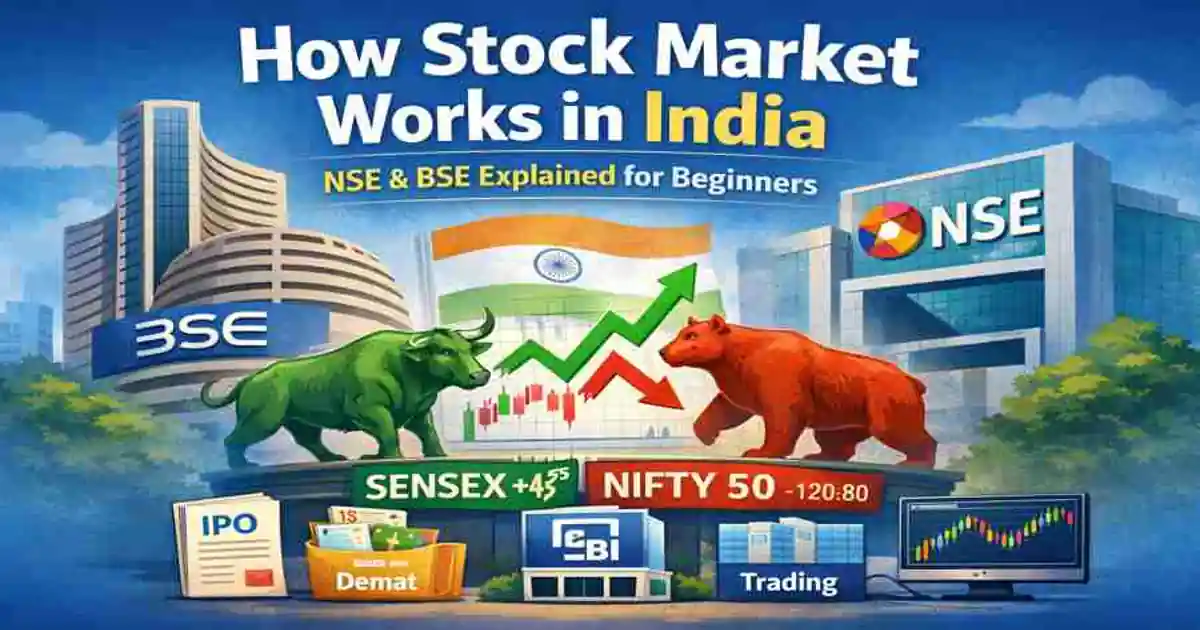
If you’ve ever seen news headlines like “Sensex jumps 500 points” or “Markets close in red today” and wondered what actually happens behind the scenes, this guide is for you.
In this article, we’ll break down how the Indian stock market works, the role of NSE and BSE, and how everyday buying and selling of shares takes place — step by step, in simple language.
No trading tips. No investment advice.
Just clear fundamentals for beginners.
What Is the Stock Market? (In Simple Words)
The stock market is a place where:
- Companies raise money to grow their business
- People buy and sell shares (ownership units) of those companies
When you buy a share, you become a partial owner of that company.
👉 Example:
If a company has 1 crore shares and you buy 100 shares, you own a small fraction of that business.
Stock Market in India: A Quick Overview
India has two main stock exchanges:
| Stock Exchange | Established | Location |
|---|---|---|
| NSE (National Stock Exchange) | 1992 | Mumbai |
| BSE (Bombay Stock Exchange) | 1875 | Mumbai |
📌 Interesting fact:
BSE is Asia’s oldest stock exchange, while NSE is the largest in India by trading volume.
What Are NSE and BSE?
🏛 National Stock Exchange (NSE)
- Introduced fully electronic trading in India
- Famous index: Nifty 50
- Popular for derivatives (Futures & Options)
🏛 Bombay Stock Exchange (BSE)
- One of the oldest exchanges in the world
- Famous index: Sensex
- Known for a large number of listed companies
📊 Did you know?
As of recent data, BSE has over 5,000 listed companies, making it one of the largest exchanges globally by listings.
How Does the Stock Market Actually Work?
Let’s understand this with a real-life flow.
Step 1: Company Gets Listed
A company first launches an IPO (Initial Public Offering) to sell its shares to the public.
Example:
When a company wants to expand factories or reduce debt, it raises funds via the stock market.
Step 2: Investors Buy & Sell Shares
Once listed, shares are traded daily on NSE & BSE.
- Buyers place buy orders
- Sellers place sell orders
- The exchange matches them electronically
💡 Price moves based on demand and supply.
Step 3: Role of Demat & Trading Accounts
To trade shares, you need:
- Demat Account – stores shares digitally
- Trading Account – used to place buy/sell orders
Banks and brokers act as intermediaries.
Step 4: Clearing & Settlement
After a trade:
- Shares are credited to buyer
- Money is credited to seller
⏱ Settlement cycle in India: T+1 day
(Trade today → Settlement next working day)
Who Regulates the Indian Stock Market?
The entire system is regulated by SEBI (Securities and Exchange Board of India).
Role of SEBI:
- Protects investors
- Prevents fraud & insider trading
- Ensures fair and transparent markets
📜 SEBI was established in 1992 to bring discipline and trust into Indian financial markets.
“The objective of SEBI is to protect the interests of investors and promote the development of the securities market.” — SEBI Act, 1992
What Are Sensex and Nifty?
These are market indices, not stocks.
📈 Sensex
- Tracks 30 large companies on BSE
- Reflects overall market mood
📈 Nifty 50
- Tracks 50 major companies on NSE
- Used widely as a benchmark
👉 When news says “Market is bullish”, it usually refers to Sensex & Nifty movement.
Why Do Stock Prices Go Up and Down?
Stock prices change because of:
- Company profits or losses
- Economic data (GDP, inflation, interest rates)
- Government policies & budgets
- Global markets & geopolitics
- Investor sentiment (fear & greed)
📉 Example:
Bad quarterly results → investors sell → price falls
Strong profits → demand increases → price rises
Trading Hours of Indian Stock Market
| Session | Time |
|---|---|
| Pre-Open Market | 09:00 – 09:15 |
| Normal Trading | 09:15 – 15:30 |
| Post-Market | After 15:30 |
🕘 Markets are closed on weekends & NSE/BSE holidays.
Is NSE Better Than BSE?
Not really — both are equally safe and regulated.
✔ Prices are almost identical
✔ Trades can happen on either exchange
✔ Liquidity may vary stock-to-stock
Most brokers automatically route orders to the best available exchange.
Key Takeaways for Beginners
- Stock market connects companies and investors
- NSE & BSE are platforms — not owners of shares
- Prices move due to demand, supply & information
- SEBI ensures market safety and transparency
- Sensex & Nifty show overall market direction
Final Words
Understanding how the stock market works in India is the first step toward financial literacy. You don’t need to trade or invest immediately — just knowing the system puts you ahead of most people.
As legendary investor Peter Lynch once said:
“Know what you own, and know why you own it.”
📌 Disclaimer
This article is for educational and informational purposes only. It does not constitute investment, trading, or financial advice. Always consult a qualified professional before making financial decisions.